Painter : Mahmoud Farshchian Water Color& Gouach نگارگر : محمود فرشچيان آبرنگ و گواش ستاره صبح MOR
MORNING STAR
ستاره صبح
81*50.8 Cm
1988
نگارگر : محمود فرشچيان
آبرنگ و گواش
Water Color& Gouach
Painter : Mahmoud Farshchian Water Color& Gouache MORNING STAR نگارگر : محمود فرشچيان آبرنگ و گواش ستاره صبح زن دختر ایستاده فیگور آدم انسان حالت رقص رقاصی لباس رخت جامه شال آستین گردن بند گردنبند دست دستان دستها پا پاها پای انگشت انگشتان انگشتها ماه ستاره مه مهتاب ماهتاب تاب پیچ خم مواج امواج موج آبی رنگ چشم ابرو چشمان ابروان رخ رو روی صورت چهره سیما لب گونه دهن دهان نگاه نظر کره سیاره ستارگان سیارات نقاشی نگارگری مینیاتور آبرنگ گواش آکریلیک


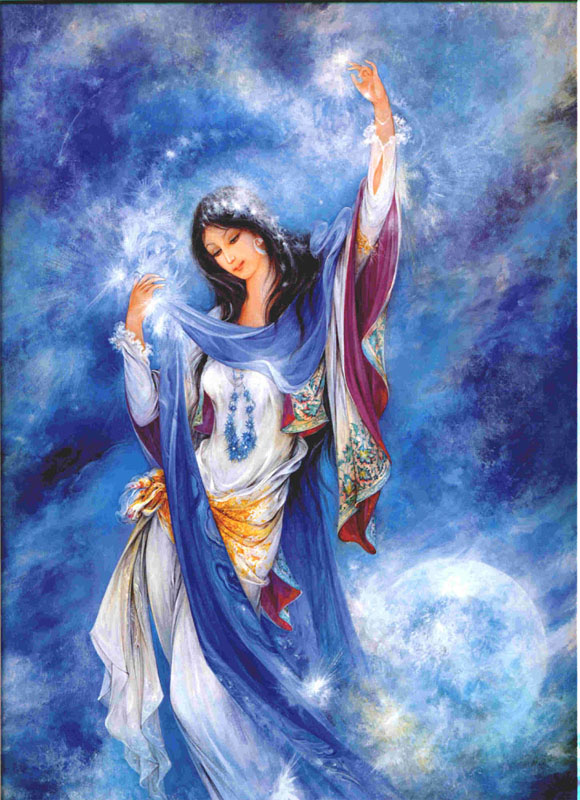




Morning Star 1988 Mahmoud Farshchian 32 in. x 20 in. Morning Star

ستاره صبح morning star نقاشی اثر استاد محمود فرشچیان farshchian mahmud mahmoud mahmood painting paint MAHMOOD FARSHCHIAN MAHMUD FARSHCHIAN mahmoud farschchian farschtschiane the great painter iranian
 |
| Morning Star 1988 | Mahmoud Farshchian | 32 in. x 20 in. |


The Daughter of the Sun - Morning Star
 “Morning
Star, the star that shines
brightest
when all other stars go dim, the star that shines not with its own light
but
with the light of the Sun…”
“Morning
Star, the star that shines
brightest
when all other stars go dim, the star that shines not with its own light
but
with the light of the Sun…”
Note:
In most but
not necessarily all cases, old Cherokee stories refer to the Sun as
female.
According to the old ones, the house of the Sun is in the east, beyond
the sky
dome, but the Daughter of the Sun used to live in the middle of the sky.
Every
day, in her travels, the Sun stopped at her daughter’s house for lunch.
It was
at this hottest part of the day that the Sun would also pause to look
down at
her grandchildren on the earth. When she saw the people squinting back
up at
her, the Sun grew angry. “My grandchildren hate me!” the Sun exclaimed
to her
brother, the Moon. “Just see how they scrunch up their faces whenever
they look
my way.” In her wrath, the Sun grew hotter and hotter, until all the
crops dried
up.
In desperation, the people looked high and low for a solution to the
problem.
Finally, the Little People came up with what seemed to be a logical
solution.
Now, the Little People are spirit folk. There are some spirit people who
are
good and some who are bad. The Little People have much in common with us
human
beings, in that, they can go either way. They may be helpful, or they
may be
mischievous. They may act wisely, or their actions may prove hurtful.
Here’s
what the Little People did in this situation: They changed two men into
snakes.
The first they changed into the Spread-Head snake. The second was
transformed
into the Copperhead. These two were instructed to travel up the sky
vault, to
wait at the house of the Daughter of the Sun. “When the Sun arrives
outside her
daughter’s door,” the Little People said, “strike quickly with your
deadly
fangs.” The two snakes slithered away to accomplish their task, but when
the Sun
arrived, her light so blinded the Spread-Head that when he struck, he
forgot to
even open his mouth to bite. He flattened his nose against the Sun.
Then, in his
fright, he rolled on his back and played dead, stinking like a rotting
carcass,
just as he does to this day. The Sun called him a nasty thing and went
on into
her daughter’s house. The Copperhead was so afraid; he crawled quickly
away
without even trying to bite, and so these two returned to the earth.
After this first failure, the Little People decided to try again. They
changed
two more men into snakes. One of these became the Rattlesnake. The other
became
the Uktin, the Great Horned Serpent. So, you see, all of these four: the
Spread-Head, the Copperhead, the Rattlesnake and the Uktin were once
men. Well,
just as the others had done, the Rattlesnake and the Uktin traveled up
the sky
vault to lie in wait outside the door to the house of the Daughter of
the Sun.
The Sun was still in there, having some lunch with her daughter.
The Uktin was very big and dangerous. His poison was so potent that even
a
little splashed on the skin could be deadly, and the mere look of the
Uktin’s
eye could kill. All the people were thinking, “As big and mean as that
Uktin is,
he is sure to do the job and kill the Sun.” But the Rattlesnake was
quicker than
the Uktin. Getting there first, he coiled up outside the door, nervously
shaking
his tail as he waited for the Sun to emerge. The Rattlesnake was so
eager, that
as soon as the door opened, he struck. But instead of striking the Sun,
the
Rattlesnake struck the Daughter of the Sun. The Sun went on her way, but
the
Daughter of the Sun died from the poisonous bite. As with the others
before
them, these two snakes returned to the earth.
The Sun burned hotter and hotter, so vengeful was she for the death of
her
daughter. The people could no longer leave the shade in the daytime. The
trees
and grasses were dying. Great fires were burning in the land. People
were
getting sick. It was really bad.
The Little People said there was only one solution. Seven men would have
to
travel to the West, to the Jusgina Ghost Country, and bring back the
Daughter of
the Sun. The Little People gave each man a sourwood stick, with
instructions on
how to use these when they arrived at the Ghost Country. The men also
carried a
large box in which to bring back the Daughter of the Sun. The final
instructions
of the Little People were these: “Once she is in the box, don’t open it,
for any
reason, until you are back here, in your own country.”
The men set out on their journey. Seven days later, arriving in the
Ghost
Country, the seven men found the people dancing in a great circle.
Positioning
themselves outside the circle, they waited for the Daughter of the Sun
to come
around. As she came by, the first of the seven men touched her with his
sourwood
stick. When she came around the second time, the next man touched her
with his
sourwood stick. This same pattern continued until all seven men had, in
turn,
touched the Daughter of the Sun with their sourwood sticks. At the touch
of the
seventh stick, she fell backward, as in a swoon. The men put her in the
box,
securely fastened the lid and headed back to their own country.
As the men walked along, carrying the box, the Daughter of the Sun awoke
and
began to complain. “I’m hungry,” she said. “Please open the box and give
me
something to eat.”
“Oh no,” the men said, remembering the warning of the Little People. “We
can’t
open the box until we are back in our own country.”
As they walked on, the Daughter of the Sun complained again. “I’m
thirsty,” she
said. “Please, oh please open the box and give me just a little sip of
water.”
“Oh no,” the men said. “We can’t open the box until we are back in our
own
country.”
Finally, the Daughter of the Sun complained again. In a faint voice she
said, “I
can’t breathe. Please, please open the box. I think I may suffocate!”
The seven men stopped and looked at each other. It was well known that a
person
could live a long time without food. There were some who had lived as
much as
seven days without water. But air was something a person could not live
without.
“Maybe we should open the box,” one man offered.
“Don’t forget what the Little People said,” another cautioned. “We can’t
open
the box for any reason.”
“But what if she dies,” yet another man said. “We’re back where we
started.”
Finally, someone offered an acceptable compromise. “Let’s open the box
just a
crack,” the man argued, “not enough for her to get out, but enough for
her to
get some air.” This course of action seeming reasonable to all, the box
was
unlatched and opened just the tiniest crack.
“What was that?” one man exclaimed. They had all seen a flash of red
light,
flying out from the box to disappear in the brushy woods.
“I don’t know what that was,” another man said, “but I think we’d better
keep
the lid closed tight on this box from now on, no matter what she says.”
The men went on their way, hearing no more complaints from the Daughter
of the
Sun. They worried that maybe she was dead. The next day, the seven
arrived back
in their own country. The box was opened, and to everyone’s dismay, it
was
empty.
When the Sun saw her daughter would not be returned to her, her wrath
turned to
sorrow. She began to cry, and the tears of the Sun threatened to flood
the whole
earth. The people tried their best to cheer her up. They sang their best
songs
and danced until their feet were sore. The heart of the Sun was touched
by this
effort, but her sorrow was not taken away. Then a flash of red was seen
in the
edge of the woods and a beautiful song was heard. Looking down, the Sun
saw her
daughter, who had become the Redbird, the Dojuwa, and had elected to
stay in the
earth. The Sun saw her daughter in the earth, and the Sun smiled.
Note: I have been told recently that the Cherokee word “Dojuwa” may not
have
originally referred to the crested redbird known as the cardinal, but
rather to
the summer tanager, the uncrested redbird of the deep forests of
southeastern
North America.
One Came From the Heavens
Of course the Uktin, the Great Horned Serpent was in the earth. He was
still
very angry and very dangerous. Even the look of the Uktin’s eye was sure
death,
not only for the person heedless enough to make eye contact, but even
for that
person’s whole family. Having failed to destroy the Sun, the Uktin
wanted to
destroy the Earth, along with all her children, and it looked as though
he would
do it. But then, one came down from the heavens. This is the one the
Cherokees
call Jiya Unega (White Otter). Now, this name does not mean this was a
white
person any more than it means this was literally an otter. It is simply
the name
by which the Cherokees knew this person. Names have significance. Colors
have
significance. White, for Cherokees, is the color of the South and
signifies new
life, new beginnings. Jiya Unega fought against the Uktin and defeated
him.
Although the Uktin had children who remained in the earth, the Great
Uktin
himself was sent to the place where dangerous beings are kept. In his
fight with
the Great Horned Serpent, Jiya Unega was horribly wounded. With one arm
torn
from his body, Jiya Unega’s blood gushed out onto the earth, and Jiya
Unega died
in the earth. But Jiya Unega did not remain dead.
Rising from
the dead, Jiya
Unega ascended into the heavens to take his place as the Morning Star,
the star that shines brightest when all other stars go dim, the star
that shines
not with its own light but with the light of the Sun, the star the
Cherokees
call Unelvnvhi Uwegi (Creator-Son).
We Cherokees understand that it was Jiya Unega who gave our people the Sacred Fire that has been kept now for some 5,089 years. Jiya Unega gave the Fire as reminder of Creator’s presence with us, and he gave us the ceremonies with which to keep the Fire. Jiya Unega, Creator-Son, instructed us that as long as we keep this Fire, we will continue to survive as a people.
Credits:
Robert Francis of Mid - America Indian Fellowship
http://salmonhouse.blogspot.com/
http://ivizlab.sfu.ca/arya/Gallery/Farshchian.htm
فهرست نقاشیهای محمود فرشچیان مینیاتوریست بزرگ ایران نگارگر نگارگری مینیاتور مینیاتوری نقاشی


 beautiful fine art - basic find all