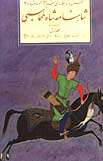
نقاشی سبک مکتب صفوی safavid style in persian iranian miniature painting اطراق کاروان

Miniatuurmaal


نقاشی ایرانی مینیاتور سبک مکتب صفوی safavid style in persian iranian miniature painting اطراق کاروان

The Master Spy Escapes c. 1562
- 1577 1.
This is a sheet from the Hamzanama of Padishah Akbar. Akbar as a young
man memorized large portions of this story and
preformed them. Possibly dyslexic Akbar was
unable to read but he had a keen mind and a vast
intellect.
His father Humayan raised an army with the help
of Shah Tahmasp and launched a civil war that
lasted 8 years. He
only gained the kingdom of Kabul in 1553 and was
only putting the kingdom back into an empire when
he died. Akbar was 14 when he became king and
this piece dates to the very early part of his
reign. Even though the Mughal school of art was
still new this is very much a Mughal painting and
very different from Persian art of the same
period.
 |
Please note the unusual hat on the man to the right. It reminds me of the flat top hats like the ones the Tadjiks wear in Afghanistan. |
 |
The Hamzanama was begun in 1562 (or 1567) and took about 15 years to complete. Rogers suggests that the large format on cotton was to allow the pictures to be held up while the story was read. Rogers, Mughal Miniatures Pp. 41. |
Related work
- Sotheby's Oriental Manuscripts and Miniatures, London UK: October 16, 1996 Lot 86.


More Oriental Rug Notes by Barry O'Connell
Mughal Art: Hamzanama The Master Spy Escapes Circa 1570
|
Country of Origin: Kabul or Mughal India Date of Origin Circa 1570 Use: JBOC Comments: Call me crazy but I think this work was started in Kabul in the reign of Humayan. I wrote about this work before in The Master Spy Escapes c. 1562 - 1577 Auction Catalogue Description: |

PROVENANCE
Acquired by a Major Fitzroy in India during the
nineteenth century.
Sold in these rooms, 16 October 1996, lot 86.
LITERATURE AND REFERENCES
Seyller J The Adventures of Hamza Smithsonian Institute,
2002, p.261, no.30
 |
CATALOGUE NOTE
A leaf from the vast Qissa-I Amir Hamza or Hamzanama,
produced for the Mughal Emperor Akbar (r.1556-1605).
Akbar was a supreme patron of the arts, and the
commissioning of the Hamzanama was the first great
artistic undertaking of his reign. The Hamzanama is the
principal cornerstone of early Mughal painting and one of
the most innovative of all Islamic manuscripts. Its
enormous size and startling compositions were quite
without precedent and were never attempted again. The
manuscript is a romance of the mythical adventures of
Amir Hamza, the uncle of the Prophet Muhammad, who is
transformed by the tale into a chivalric hero who travels
the world fighting infidels and dragons. Although the
legends of Amir Hamza go back at least to the eleventh
century, Akbar's Hamzanama represents a unique form of
the text, derived as it was from an oral tradition - in
this version it was possibly never finished and remains
unpublished.
Work on the manuscript had almost certainly begun by
1564, since the chronicler Abu'l Fazl describes part of
the text being read out to Akbar during an elephant hunt
near Narwar in that year (Abu'l-Fazl, 1907-39, II,
p.343). The Hamzanama is said to have taken fifteen years
to complete. It was described as being in twelve vast
unsewn volumes, painted on cotton, with a total of some
fourteen hundred paintings with text on their versos,
probably (though scholarly opinion is divided on this
point) so that they could be held up by the court reader
before Akbar and recited from the back. Fifty artists are
said to have worked on the illustrations. Akbar's father
Humayun had summoned to India the greatest book
illuminators of Persia, including Mir Sayyid 'Ali and
'Abd al-Samad, who had both worked on the Shahnama of
Shah Tahmasp (The 'Houghton Shahnama', of which four
leaves were sold in these rooms, 23rd April 1996, lots
11-14), and both artists were employed to supervise the
Hamzanama project.
The Hamzanama was recorded as being in the library of
Akbar at the end of his life, and it was inherited by
Jahangir (1605-1628) and Shah Jahan (1628-1659). It
probably remained intact in the royal palace at Delhi
until the Mughal collections were looted during Nadir
Shah's sack of the city in 1739 when many leaves of the
book were taken back to Persia and almost all faces
depicted in the Hamzanama were deliberately smudged.
Seen on www.Sothebys.com
More Oriental Rug Notes by Barry O'Connell
‘Islamic art dissolved line between East and West’
New Delhi, Sep 16, Art as it developed under Islam reached a level that can be compared to the Renaissance period because it took in various influences and even played a role in dissolving the divide between the East and the West, says art historian Nuzhat Kazmi in a new book.

Illustrations from the stories of Hamza patronised by Mughal Emperor Akbar
“I think the most enduring element of Islamic art is its ability to accumulate and open its resources and aesthetics into functional objects and visuals. Islamic art has a plastic quality and a very different sensibility. It does not remove art from its surroundings but rather responds to it. Islamic art is minimal, mature and always ready for a dialogue,” Kazmi, who heads the Art History and Art Appreciation Department at the Jamia Millia University here, told IANS in an interview.

Ham Nama was the largest collection of painted poetry in cloth produced in the Persian language.
A Commonwealth scholar at the School of Oriental and African Studies, University of London, Kazmi has travelled across Europe and explored Mughal and European interaction in arts.
Kazmi’s new book, “Islamic Art: Past and Modern”, traces the history of Islamic art when it peaked in the 16th century under the patronage of Mughal emperor Akbar to the contemporary 21st century idioms. The volume, published by Roli Books, is priced at Rs.695.
“It took me three years to put together the book. I visited places like Cairo and Lahore to see what is happening in modern Islamic art. The most exciting things are taking place in Iran and Turkey where younger artists are drawing inspiration and idioms from ancient Islamic culture into modern architecture, body art and post-modern installations. Islam is looking at art with very open eyes,” Kazmi said.
“But I think the most beautiful period of Islamic art is the Indian medieval art corresponding to Renaissance in Europe. You see the Baroque and the Mannerist influences in Islamic art and a movement back and forth between classical and anti-classical genres. You have the Ottomans and the Mughals. The world was becoming a smaller place characterised by different undercurrents. Islamic art was taking all of it in,” Kazmi explained.
The historian attributes the spread of Islamic art primarily to territorial expansion.
“As the influence of Islam expanded, Muslims realised that they may gain an imperial advantage by adapting a visual language,” she said.
Islam transformed local cultural idioms of the communities that came directly under its control.
“Figures, portraits and stylised (deco-style) architecture became central to Islamic artistic language,” Kazmi said.
Islamic art to a large extent succeeded in dissolving the divide between the East and the West. Baroque artists like Rembrandt, romantics like Delacroix and the modernists like Henri Matisse were influenced by Islamic culture and art, she says in the book.
The book is spiced with anecdotes, details and stunning colour spreads of paintings, artefacts and architecture.
“Akbar was a patron of the arts. As Akbar’s chronicler Abu’l Fazl observes in ‘Ain-i-Akbari’, the (Persian) story of Hamzah was represented in 12 volumes and clever painters made the most astonishing illustrations for no less than 1,004 passages of the story,” Kazmi says in her book.
The Mughals assimilated the “Renaissance illusionism and figures with intelligence”. A wonderful example of this fusion in the book is a fantasy painting of emperor Jahangir in the Renaissance realistic style. The emperor appears at a window of a double-storeyed fort holding the “imperial orb (a precious stone)” while “Jesus Christ is shown carrying his cross” at the window below, the historian says.
Paintings, miniatures and architecture apart, calligraphy was another important component of Islamic art that was “scientifically developed into an exquisite art form”, says Kazmi.
“To record the word of God revealed to his Prophet was an honour. Today we have many systems of writing within the Islamic traditions. Calligraphy became the supreme art in the very early days of Islamic culture. It was practised on not only paper but also metal, ceramics, leather, textiles and carpets.”
Writing the Koran was considered auspicious. “Mughal emperor Aurangzeb, a skilled calligrapher, apparently earned his livelihood by copying the Koran,” Kazmi pointed out.
فهرست نقاشی سبک مکتب صفوی صفویه صفویان مینیاتور نگارگری آبرنگ Safavid style painting
 |  |  |  |
 | |||
 |  |
| |
 |  |
| |
|  | ||
 |  |
|  |
|
|  |
|
|  |




 beautiful fine art - basic find all